Directing remains the centre.
Independent cinema, screenwriting, editing and sound provide the grammar. AI changes the production surface, not the need for intention.
Generative tools are not a replacement for direction. They become useful when shot design, performance, movement, sound and editing remain part of one authored system.
Carmine Cristallo Scalzi works as a filmmaker, writer, editor, illustrator, musician and AI cinema researcher under the IAMCCS name.
The work starts from cinema rather than from software. Generative video is approached through framing, blocking, camera intention, temporal continuity, sound, editorial rhythm and the relation between one shot and the next.
That approach extends from independent filmmaking into production tools: Shotboards for planning, model-specific direction, audiovisual continuity, local image generation and editing, and custom ComfyUI systems that keep creative decisions visible instead of burying them inside a graph.
Independent cinema, screenwriting, editing and sound provide the grammar. AI changes the production surface, not the need for intention.
IAMCCS develops workflows for MiniMax H3, LTX, WAN, continuity, audio and editorial handoff in ComfyUI.
Illustration, music and image research are treated as parts of the same authored visual and sonic practice.
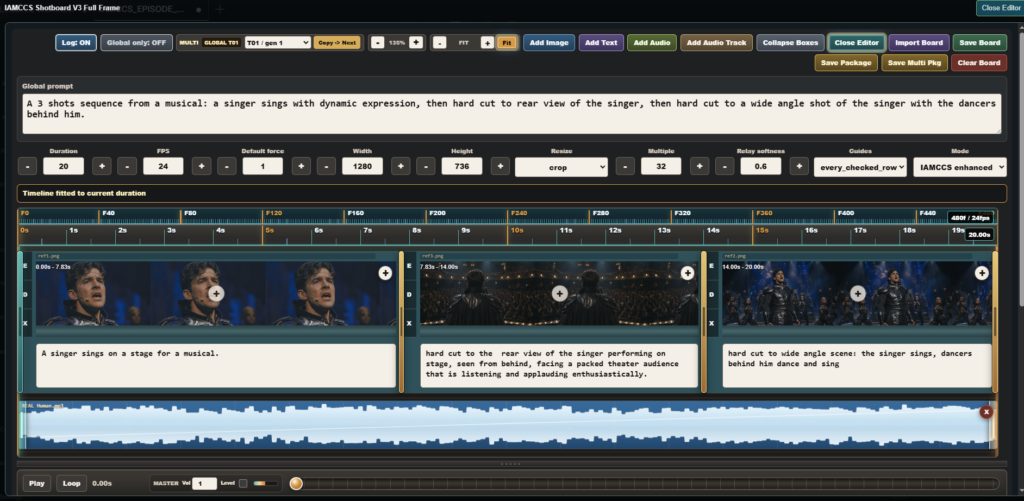
A cinematic workflow needs persistent context: global intention, local shot direction, guide media, timing, motion state, audio state and a defined editorial destination. IAMCCS tools are built around that production problem.